
The Atlantic Current, Ep. 54: Irish "Vetocracy", Dark Secrets, And The World Cup (Notes, Part I)
Tull and Vince talk the tech backlash, fake scandals in the US, and real horror in the UK

Tull and Vince tour a number of stories that highlight broader problems across the United States and Europe. Manna’s decision to pause operations in Ireland leads to claims that the country has become a “vetocracy” and highlights a rising backlash against tech. In the North, Jeffrey Donaldson faces punishment for his crimes. In the US, Republicans continue to argue — with hysterically poor evidence — that others should as well. But the episode closes on a lighter note, with a look at the success of the World Cup and some timely craic on what it tells us about Europeans and Americans.
Episode Links:
PodLink (all platforms)
(Editor’s note: we took some extra time in the notes here to delve into details of a couple topics, and so given length the show notes will actually come in two parts. We’ll focus on the Donaldson case in Part II, likely late Tuesday night or Wednesday morning West Cork time.)
The Battle Over Manna
Tull and called out a couple of posts from politicians on the decision by Manna Air to pause operations in Ireland. The episode opened with a quote from Stripe’s John Collison, which too came from the platform:


Here is Cllr Conor Reddy’s statement. The ‘ratio’ here (replies to likes) actually isn’t that bad, which in turn supports the idea of a broader anti-tech pivot, even at the cost of a few local jobs.


To be fair to Reddy, he later made a case that isn’t purely spite for the sake of spite — but too perhaps captures rising anti-tech (and anti-billionaire) sentiment:

The exchange between Maeve O’Connell, Fine Gael TD for Dublin Rathdown, and Healy:


The New York Times Applauds Congress Actually Doing Something
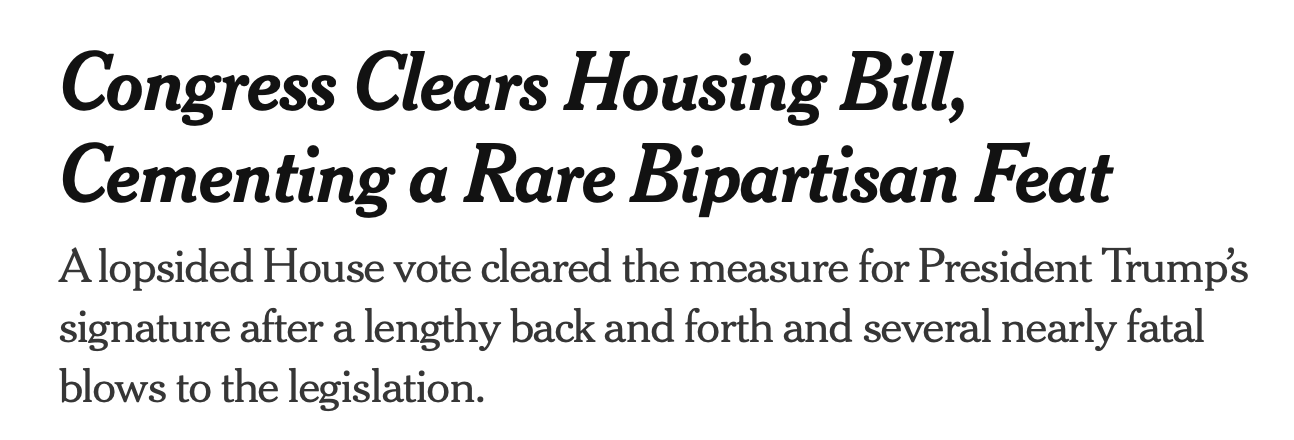
Vince couldn’t quite remember the headline about the housing bill passed by the U.S. Congress this week. Here it is, with the New York Times citing “a rare bipartisan feat” of actually passing a law that could, conceivably, help someone or do something:
The Horseshoe Theory Comes For Artificial Intelligence
Vince said on the pod that the idea of the federal government taking stakes in artificial intelligence developers was “an incredible example — and there are more than you might think — of Donald Trump and Bernie Sanders agreeing.” He wasn’t exaggerating.
On June 10, Trump for a second time floated the idea of AI companies “giving something back to the public”. A week later, Sanders (I-Vt.), the left-wing, technically independent Senator, announced a similar plan.
No doubt, the two men would disagree — perhaps substantially — on how large the stakes would be. Sanders proposed a one-time tax of fifty percent of the stock in the major AI developers, to go into a sovereign wealth fund similar to those of Norway or Saudi Arabia. (Here, too, there are some similarities: Trump has often proposed various forms of an American sovereign wealth fund, and issued an executive order last year which aimed to move the government toward such a vehicle.) It seems unlikely that Trump would go for such a figure.
But the proposed policy from the Administration is a sign both of how unconventional Trump’s politics can be, and how often his supporters will tolerate something that coming from someone on the left they would instantly decry as communism. (Such a move would be more socialism than communism, of course, but communism remains the right-wing insult of the moment.)
What The F—- Happened To Rand Paul?
Rand Paul has served as a US Senator from Kentucky since 2011. He is the son of Ron Paul, likely the best-known libertarian of the past several decades (and a two-time candidate for President). Rand Paul has mostly kept his father’s principles: he sees himself as a strict defender of the Constitution, has repeatedly battled with the legacy Republican establishment over foreign intervention (Paul is a classic isolationist), and will toe the line on spending (at least to the extent that anyone in Congress will do so).
Of late, however, he has fixated on a seemingly bizarre insistence that Anthony Fauci, a long-time health official who led America’s response to the novel coronavirus pandemic, lied to Congress. The details from Paul are quite intricate, relying on declassified documents that are supposedly bombshells, and perhaps not quite worth arguing on a point-by-point basis, particularly given that others have given impassioned and informed rebuttals:

But Paul’s case falls apart when looking at a single slide (one we’ve posted a few times on X in the “someone is wrong on the Internet” way it’s easy to fall into). It is the opening graphic in a report released by the US Senate Committee on Homeland Security & Government Affairs, of which Paul is the chairman:
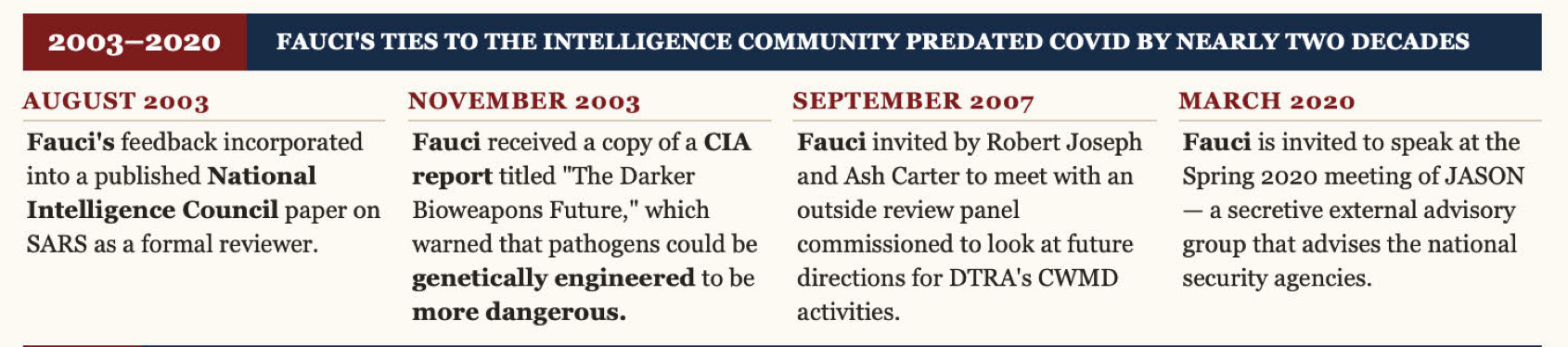
This is supposed evidence for Paul’s broader claim that Fauci influenced — or outright directed — American intelligence agencies to obscure the ‘true’ nature of the pandemic: at a lab in Wuhan, China, rather than a so-called “wet market”. It is astonishing in its brazen message: that no one will read the text, but only the headline. Fauci’s “ties” to intelligence over two decades have a gap of over twelve years, and one of the four (!) examples given is one in which he (as a senior government official) received a copy of a report from the Central Intelligence Agency.
Adding to the seemingly intentional distortion, Paul has approvingly cited documents released by outgoing Director of National Intelligence Tulsi Gabbard that supposedly prove Fauci’s role in (depending on the day and the telling) orchestrating the pandemic. Here, too, others have provided detailed arguments as to why Gabbard is being deceitful. And here, too, one look at the “evidence” suggests at the very least extreme caution.
Gabbard released these bombshells in four documents, which include previously publicly-available information, including government blogs (!), some of which are repeated in multiple documents. Redactions are heavy in email communications, and there is no context given. Nor is there any kind of “smoking gun” or even remotely clear evidence of Gabbard’s accusations.
But both Paul and Gabbard understand how the game now works. It’s the headlines that matter, and their ‘disclosures’ sparked hundreds of podcasts and YouTube videos (and Substacks) repeating the accusations without questioning the evidence. (In some cases, clearly without reading the evidence.) Fox News too will air the allegations without any criticism.
And so the question Vince asked on the podcast — where are the reasonable people on the right? — seems to have no answer. At the very least, Paul seems to have left that group, and of the few that remain, as we have discussed previously, many have been pushed out.
Ep. 41: Poor Europeans And Bad Journalism
Tull brought up our previous episode on the idea from some quarters of the US that Europeans are poor. (That discussion was sparked by a Wall Street Journal op-ed that Tull mocked later in today’s episode.) Here are the show notes and links for that episode, which remains one of our most popular (and in both the data which show how long listeners stick around, and the clearly unbiased opinion of the hosts, one of the best):

Anti-Semitism On The Right
Vince noted that despite the historic support for Israel from the Republican Party establishment, there has been a longstanding strain of anti-Semitism on the American right. Ron Paul himself faced those allegations, in large part because of anti-Jewish comments published under his name in a newsletter in the 1980s and 1990s. (Paul would later claim he neither wrote nor read those words.)
This may be a family issue. In May, Rand Paul’s son William launched an anti-Semitic tirade at (non-Jewish) Republican congressman Mike Lawler in a Washington D.C. pub. Fittingly for this episode, he told Lawler to “watch more Tucker Carlson”. William Paul subsequently apologized and (via his X account, handle TastyBrew1776, and, no, that is not a joke) blamed a drinking problem for his behavior.
One of the best books on the right is by John Ganz, who writes here at Unpopular Front:

In When The Clock Broke, Ganz deeps into the roots of the right-wing movement that existed under Trump, a movement built through underground newspapers, newly-established journals, and even the third-party presidential campaign of Ross Perot in 1992, which was much stranger (and conspiratorial) than is commonly remembered. But Ganz also points out multiple times in which the movement veered into racism and/or anti-Semitism, as witnessed by the nationwide popularity of David Duke in the late 1980s and early 1990s. Duke was a former Grand Wizard of the Ku Klax Klan who was elected to the Louisiana state legislature and ran credible campaigns in the state for Governor and the US Senate. Ganz makes clear that the strain Tull sees now is not as new as outside appearances might suggest.
Bobby Healy’s Money Quote
Our first-ever quote in this section from someone not on the pod, but seems worthwhile to give Healy more voice. This is from Manna’s statement, via Chuck Martin’s Substack (Chuck is no relation to Vince):
The absence of a clear national policy framework for commercial drone delivery means there is currently no defined pathway for the sector to scale in Ireland. In the absence of such a framework, decisions are assessed locally, creating uncertainty around the planning and infrastructure requirements needed to support commercial drone delivery at scale.
Tull’s Money Quotes
On why John Collison is right in calling Ireland a “vetocracy”:
Individuals are doing incredible amount of damage to the long-term infrastructure ambitions of this government and of this country. And the reality of the situation is if that infrastructure doesn’t get built, the country’s going to grain to a halt economically.
On a complaint that is familiar to many listeners and readers outside Ireland as well:
Everything is grinding to a halt. You’re stuck in traffic for four hours in this weather outside. And why can’t Ireland build anything?… We’ve spoken about this before. America can’t build anything, Canada, Australia, all the Anglophone countries, all the former colonies. I’m happy to blame the UK for this for common law. But and I think that Collison is right: we are a vetocracy.
Vince’s Money Quotes
On why tech leaders have pushed back so hard against US regulation:
What everyone in tech says… is basically the US needs to do it because if we don’t win, China will win and then we’re all screwed. And they have used that argument to shut down dissent, both in terms of D.C. and state-level governments, as well as tried to use that that argument on the public.
On why the growth of artificial intelligence coincides with a political movement entirely incapable of managing it:
You’re saying — reasonably — that we need a balance, right? We should have access to this information. We do need data centers for the things that society wants and in some cases that are good for society.
We have no mechanism left in the United States to have that balanced argument.