
The Atlantic Current, Ep. 56: Live On Tape From Ireland
Vince and Tull do their first (!) in-person show, covering everything from America's 250th to a possibly dodgy Irish mayor to Donald Trump, crypto billionaire

For the first time, Tull and Vince record in person from an undisclosed location in Ireland. The witty, wide-ranging conversation covers America’s 250th birthday (and why Vince is fine missing it), a potential scandal in Galway, and the collapse in cryptocurrency prices.
Article Links:
Irish America 250
Tull mentioned the campaign aiming to celebrate the contributions of Irish-Americans alongside America’s 250th birthday. Irish America 250 is the name of that project, and Irish-American listeners can visit their home page to submit their own story or use the hashtag #MyIrishStory.
The Cork Man Who Invented The USA
From RTE in April:
In January 1776, during the American War of Independence, Cork-born Stephen Moylan, Muster-Master General to George Washington's forces, wrote to his friend Colonel Joseph Reed that he "should like vastly to go with full and ample powers from the United States of America to Spain", to seek European aid for their cause.
That article, from Victoria Pearson at Ulster University, points out that Moylan’s letter remains the earliest-known document to refer to the “United States of America”. As Tull noted, no Cork men have become president, but this is a feather, perhaps, in the Rebel County’s cap.
Trump Outearns The Crypto Industry
Here is the incredible chart Vince cited on the pod from a Bloomberg article this week, showing that Donald Trump alone had earned more profit from cryptocurrency than the biggest American cryptocurrency firms. (Note that this does exclude Binance, which likely cleared Trump’s haul.)
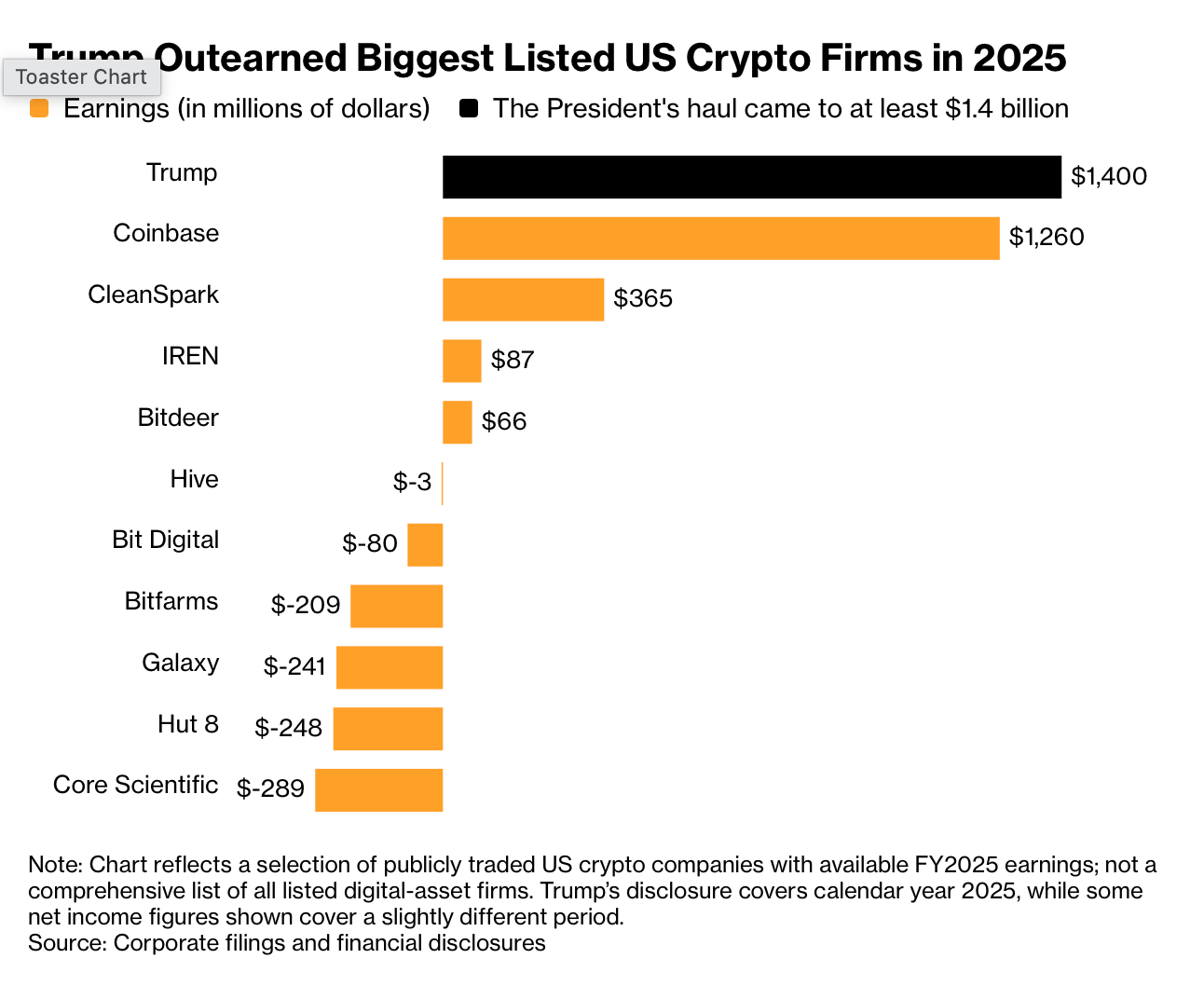
The graph is all the more stunning given that Coinbase, CleanSpark, and IREN combined have a market capitalization over $60 billion. These are not small companies — and primarily through the sales of memecoins and governance tokens for World Liberty Financial, last year at least Donald Trump outearned each of them.
July 2nd, Not July 4th
Vince noted that July 4th is perhaps an odd choice for America’s Independence Day, given that true independence was not achieved for years after the 1776 signing of the Declaration of Independence. The Constitution was not signed until eleven years later.
But as Republican Governor Ron DeSantis noted on Twitter this week, one prominent Founding Father thought even the current date was incorrect. John Adams, a key figure in the independence movement and the second US president, told his wife that July 2nd, not July 4th would be “the great anniversary festival”.
In one sense, it’s ironic that Adams was proven wrong: in one of history’s great coincidences, both Adams and his successor Thomas Jefferson died on July 4, 1826, 50 years after the day the nation adopted as the beginning of its existence.
Update: Ep. 39: $200 Crude, 16% Vote Share, And 86 47
In Ep. 39 (and others), Vince and Tull talked about the potential for crude oil prices to skyrocket — and stay high — during and after the US/Israel attacks on Iran. But that actually hasn’t happened:
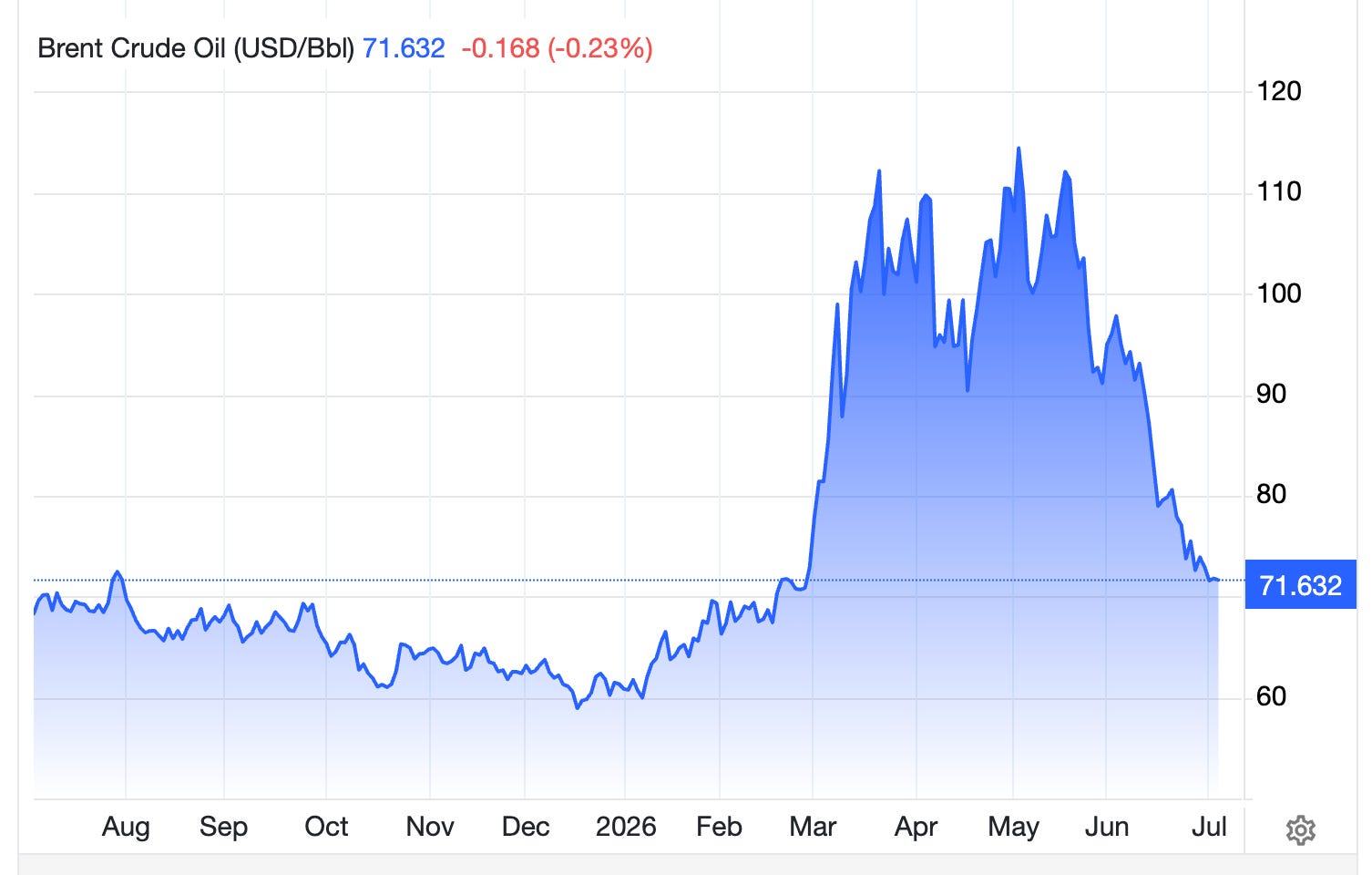
In the podcast’s defense, many others made similar arguments that proved to be incorrect. The Economist wrote a mea culpa on the subject on Thursday morning. Oil executives who were forecasting months, if not years, of supply disruption seem to have been overly optimistic (for their shareholders) and overly pessimistic (for the rest of us).
We made a similar point in an update last month, but with oil essentially back where it was, there is a broader theme here. The critics of Donald Trump have been simply wrong in terms of forecasting the economic impact of many of his policies. Tariffs were projected to drive enormous inflation and empty shelves; neither has played out. The push to deport illegal immigrants was supposed to decimate the agricultural industry (and send prices soaring). That, too, hasn’t happened. Inflation is up, but in the broader (multi-decade) context it’s not that high, and sinking crude prices clearly played a role. Similarly, the massive budget deficits enshrined in last year’s Big Beautiful Bill were supposed to drive interest rates higher. Here, too, Trump has been mostly right and his critics essentially wrong, at least in terms of these predictions.
It leaves an interesting and perhaps unsolvable dilemma. It’s hard to argue that either the Iran excursion or the haphazard, exceptionally volatile institution of tariffs (before most were struck down by the Supreme Court) were the result of long-term thinking focused on potentially ill effects. Yet many of Trump’s critics did that — and have consistently been proven wrong.
Is it luck? Trump’s ability in both terms to ride economic booms that are more the result of structural factors than any of his actual policies? Or is there something to the idea that Trump’s economic/political/financial instincts reflect some deeper understanding?
Whatever the answer (and there likely is more than one), each debare over economic policy likely winds up strengthening the Trump movement. It’s easier to dismiss traditional media and “elite” academics when their predictions of doom keep falling flat. Similarly, Trump and his acolytes can claim “bias” (as discussed in this episode) without much pushback.
That, of course, is part of the Trump movement: a closed-mindedness toward negative information and toward anyone who is not part of the movement. But, of course, it’s not that hard to see one reason why that closed-mindedness exists: a belief within the movement that there are coordinated efforts to bring the president down. The more innocent, and more likely, explanation is that traditional analyses just didn’t work. For many American voters, that’s precisely the point: what is the use of academics and journalists if, over and over again) they can’t get the story right?
The Daily Mail on Helen Ogbu
Here is the article from the Irish Daily Mail on Helen Ogbu’s seemingly incorrect timeline. And here are tweets from the author, Brian Mahon, pushing back on personal attacks and arguing that Labour leader Ivana Bacik also has questions to answer.
Update, Ep. 52: Yes, It Was A Pogrom
Sam McBride, the excellent journalist at the Belfast Telegraph, has continued his work on the riots in the city last month. In an article this week, he claimed that he was assaulted while reporting on the unrest in the city.
Meanwhile, McBride’s claim that loyalist paramilitaries were a key part of the unrest last month was initially denied by the leaders of police in Northern Ireland, only for the police service to reverse field and say that paramilitary organizations were a key part of what happened.
Clearly, this is a story that hasn’t yet ended: Vince and Tull discussed it at length in Episode 52.
Listen here:
Vince’s Money Quote
On America’s 250th:
it really is a perfect representation of where we are. We should be a country that can celebrate its own birthday.
Tull’s Money Quote
On why Ireland has never coalesced around a specific Independence Day:
It’s about keeping everybody happy in Ireland. And you, as an Irish-American Vince, you know you can’t keep everybody happy in the family, let alone a whole bloody country.